BlueVoyant AI is an agentic security operations platform that pairs AI agents with expert analysts. I designed its first onboarding experience for new and existing clients, researched it with clients running complex Microsoft environments, and helped launch it in Europe and the USA.
Every new security client was set up by hand. Microsoft permissions were chased over email, data was re-typed from Salesforce, and clients waited 4–6 weeks to see a single alert.
Interviewed existing clients with complex environments and the deployment team, designed a guided onboarding from Microsoft Graph authorization to a final review, worked with engineers on edge cases, and joined client launch calls in Europe and the USA.
The product shipped. Onboarding was designed to take contract-to-data-visibility from 4–6 weeks to under a day, and a PMO dashboard tracked the first 15 pilot clients by hand, then every client automatically.
BlueVoyant AI combines AI agents with human security experts to help security operations teams triage alerts, investigate incidents and respond faster. Before a client could see any of that, their Microsoft security environment had to be connected, permissioned and deployed. I owned that first experience — the onboarding every new and existing client goes through before the platform can protect them.
Manual configuration across several internal teams stretched every go-live.
Clients were unsure which Microsoft roles and consents they needed.
No self-service and no visibility while setup happened behind the scenes.
Deployment and engineering teams were pulled into nearly every step.
I interviewed existing clients with very complex Microsoft environments — the people who would feel every rough edge first — along with the deployment, PMO and implementation teams who had been onboarding clients by hand. Every design decision traced back to what we heard.
Clients needed the exact admin role named up front, and to know why each permission was required.
Many clients, especially in Europe, route access approvals through formal change boards and can't finish in one sitting.
Finishing onboarding isn't the same as full go-live, and the experience had to say so.
When a permission check fails, people need to know exactly what to fix and who can fix it.
Due to confidentiality, working-session details and real product screens aren't shown. The screen below is a mockup recreated for this portfolio; I'm happy to walk through the real work in an interview.
A guided onboarding that is bounded, honest and never a dead end — each step clear about what it needs and transparent about what it accesses.
Sign in with the right Microsoft admin role, named clearly before the client starts.
Every permission listed with what it's used for, so a change board can approve it.
Automated deployment with live progress, so the screen never looks frozen.
Clients choose which actions the platform can take on their behalf.
Who BlueVoyant contacts, and in what order, when something needs attention.
One page to confirm everything before going live.
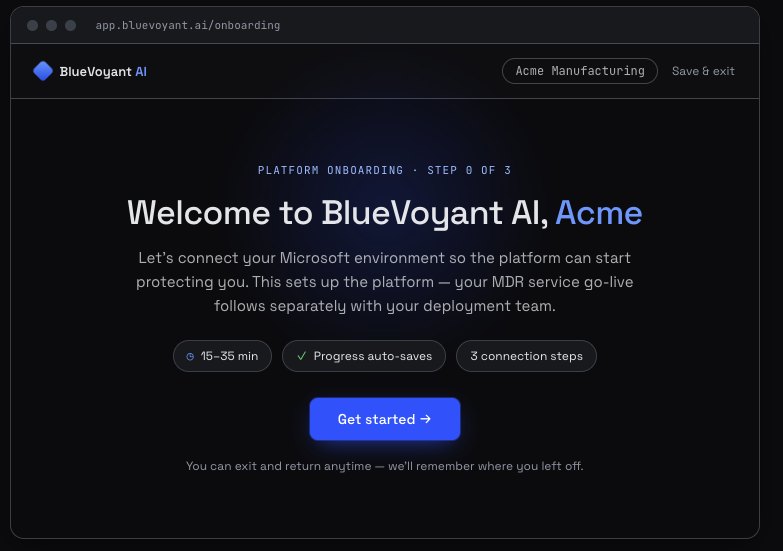
Upfront time estimate and step count, and clear about what onboarding does and doesn't include.
Save and exit, skip for now, and send a step to a colleague. Errors name the next action.
Every permission and access request is named and explained.
I worked side by side with engineers on troubleshooting and edge cases: failed permission checks, missing admin roles, partial deployments and multi-tenant setups. In security, the unhappy path is the normal path, so it got as much design as the happy one. We launched and shipped the product, and I joined the launch calls with clients in Europe and the USA alongside our engineers — seeing firsthand where clients hesitated and fixing it for the next ones.
Launch created a new need: the Deployment Services PMO had to see where every client was in onboarding. I designed a PMO dashboard to track it.
Tracked the first 15 pilot clients manually, so we could learn what the team actually needed to see.
Automated tracking for the rest, so the PMO could manage exceptions instead of chasing status.
Onboarding was designed to take a client from signed contract to their own security data in under a day, down from 4–6 weeks of manual work. The product shipped, pilot clients onboarded across Europe and the USA, and the PMO moved from being the bottleneck to managing exceptions.
Tracing decisions to what clients told us kept debates about evidence, not opinions.
Failure states in security onboarding are the normal path.
Naming exactly what's accessed reduced friction more than reassuring copy could.
Time-to-value figures are design targets for the automated flow, measured against the prior manual process.
I design research-driven onboarding that turns day one from a bottleneck into momentum.